



 Login
 Register

Articulation Word Bank: By Syllable and Position
The Articulation Word Bank: By Syllable and Position is a comprehensive, user-friendly resource created for Speech-Language Pathologists (SLPs), Communication Disorder Assistants (CDAs), and parents. It features clearly organized word lists for all English speech sounds, sorted not only by initial, medial, and final positions but also by syllable count—making it easier than ever to target specific speech goals.
Whether you're planning therapy sessions, running articulation drills, or supporting home practice, this bank simplifies your workflow and saves you time. Each list is designed to be practical, accessible, and ready to use.

About These Word Lists
The goal of these word lists is to support speech therapy for individuals with various speech and language disorders—not just to present isolated vocabulary. In some cases, compound words or short, functional phrases are included in the two-syllable and three-or-more-syllable sections. While not all items are single, dictionary-defined words, many are compound forms or commonly used lexical units (like ladybug or garlic-press) that function as single meaningful units in everyday speech. These selections are intentional, as they offer valuable linguistic and therapeutic opportunities, often making practice more engaging, contextually relevant, and effective for generalization into natural communication.
Vocabulary was also chosen with age appropriateness in mind. Some words are ideal for children due to their simplicity and familiarity, while others may be better suited for older children, teens, or adults because of their complexity, tone, or usage. This range allows for flexibility in therapy, so practitioners can select vocabulary that best matches the developmental level, personal background, and communication goals of each client. The intent is to provide options—not restrictions—so that speech therapy remains both functional and respectful across age groups.
Plosives (Stops)
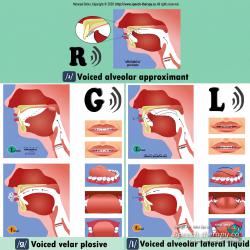
Plosives (Stops) are speech sounds made by completely blocking the airflow in the mouth for a short time and then releasing it suddenly, creating a burst of sound. This happens when two speech organs, like the lips or tongue and the roof of the mouth, come together to stop the air. In English, common plosives include /p/, /b/, /t/, /d/, /k/, and /g/. Some are voiced (with vocal cord vibration, like /b/ and /d/) and some are voiceless (without vibration, like /p/ and /t/). Unlike nasal sounds such as /m/, where air flows through the nose, plosives completely stop the airflow before releasing it.
- "P" /p/ – Voiceless Bilabial Plosive - by syllable & position → Download /p/ Word List (PDF)
- "B" /b/ – Voiced Bilabial Plosive - by syllable & position → Download /b/ Word List (PDF)
- "T" /t/ – Voiceless Alveolar Plosive - by syllable & position → Download /t/ Word List (PDF)
- "D" /d/ – Voiced Alveolar Plosive - by syllable & position → Download /d/ Word List (PDF)
- "K" /k/ – Voiceless Velar Plosive - by syllable & position → Download /k/ Word List (PDF)
- "G" /ɡ/ – Voiced Velar Plosive - by syllable & position → Download /ɡ/ Word List (PDF)
Fricatives
Fricatives are speech sounds produced by narrowing the space between two speech organs to create continuous airflow and friction. Unlike plosives, the air is not completely blocked, but squeezed through a tight space, which creates a hissing or buzzing sound. In English, fricatives include /f/, /v/, /s/, /z/, /ʃ/ (as in "shoe"), /ʒ/ (as in "measure"), /θ/ (as in "think"), and /ð/ (as in "this"). Some are voiced (like /v/ and /z/), and others are voiceless (like /f/ and /s/).
- "F" /f/ – Voiceless Labiodental Fricative - by syllable & position → Download /f/ Word List (PDF)
- "V" /v/ – Voiced Labiodental Fricative - by syllable & position → Download /v/ Word List (PDF)
- "Th" /θ/ – Voiceless Dental Fricative - by syllable & position → Download /θ/ Word List (PDF)
- "Th" /ð/ – Voiced Dental Fricative - by syllable & position → Download /ð/ Word List (PDF)
- "S" /s/ – Voiceless Alveolar Fricative - by syllable & position → Download /s/ Word List (PDF)
- "Z" /z/ – Voiced Alveolar Fricative - by syllable & position → Download /z/ Word List (PDF)
- "Sh" /ʃ/ – Voiceless Post-Alveolar Fricative - by syllable & position → Download /ʃ/ Word List (PDF)
- "Zh" /ʒ/ – Voiced Post-Alveolar Fricative - by syllable & position → Download /ʒ/ Word List (PDF)
- "H" /h/ – Voiceless Glottal Fricative - by syllable & position → Download /h/ Word List (PDF)
Affricates
Affricates are speech sounds that begin like plosives, with a complete blockage of airflow, but end like fricatives, with a gradual release that creates friction. This combination gives affricates a unique sound quality that blends stopping and squeezing air. In English, the two main affricates are /tʃ/ (as in "chop") and /dʒ/ (as in "jump"). /tʃ/ is voiceless, and /dʒ/ is voiced.
- "Ch" /tʃ/ – Voiceless Post-Alveolar Affricate - by syllable & position → Download /tʃ/ Word List (PDF)
- "J" /dʒ/ – Voiced Post-Alveolar Affricate - by syllable & position → Download /dʒ/ Word List (PDF)
Nasals
Nasals are sounds produced by completely blocking airflow in the mouth while allowing air to pass through the nose. The soft palate (velum) lowers to open the nasal passage, giving these sounds their characteristic resonance. In English, the nasal sounds are /m/, /n/, and /ŋ/ (as in "sing"). All nasal sounds in English are voiced, meaning the vocal cords vibrate during production.
- "M" /m/ – Voiced Bilabial Nasal - by syllable & position → Download /m/ Word List (PDF)
- "N" /n/ – Voiced Alveolar Nasal - by syllable & position → Download /n/ Word List (PDF)
- "Ng" /ŋ/ – Voiced Velar Nasal - by syllable & position → Download /ŋ/ Word List (PDF)
Approximants
Approximants are speech sounds made by bringing two speech organs close together, but not close enough to create turbulent airflow or friction. They are smoother and more vowel-like than other consonants. English approximants include /w/, /j/ (as in "yes"), /l/, and /ɹ/ (as in "red"). These sounds are all voiced and are often used in speech to create smooth transitions between other sounds.
- "L" /l/ – Voiced Alveolar Lateral Approximant - by syllable & position → Download /l/ Word List (PDF)
- "R" /ɹ/ – Voiced Post-Alveolar Approximant - by syllable & position → Download /ɹ/ Word List (PDF)
- "Y" /j/ – Voiced Palatal Approximant - by syllable & position → Download /j/ Word List (PDF)
- "W" /w/ – Voiced Labio-Velar Approximant - by syllable & position → Download /w/ Word List (PDF)